About this read along

What Is This?
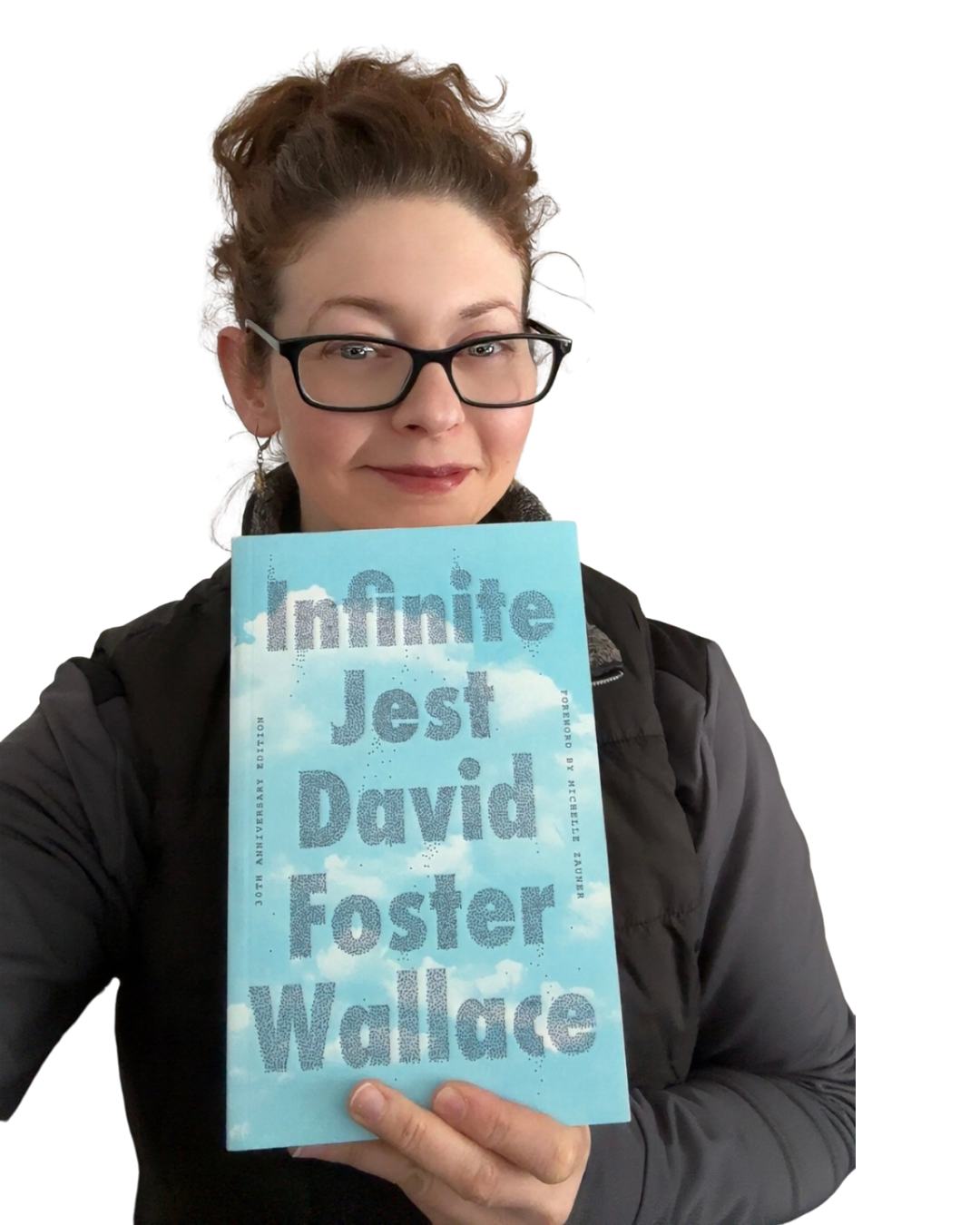
Jest Read It is a year-long, premium, community-based reading program for Infinite Jest.
We will start April 1, 2026 and finish in April 2027. Over the course of the year we'll read about 70–90 pages a month, we talk about it, and ideally no one rage-quits when they get confused a few months in.
That’s the structure.
But also it's about community. It's about taking back a decidedly anti-elite book that's become elitist, and reading it without the lit-bro energy it usually attracts.
Yup, it’s a little insane. But also… it’s a big weird book and we’re doing it together to celebrate some really weird times.
Join me?
But what is this really?
Jest Read It is a 13-month guided reading experience for curious, real humans who have always meant to read Infinite Jest — and then didn't, because life happened, or they felt victimized by the endnotes, or page 223 happened. (Apparently it's a thing, I don't know yet either!)
We're not going to pretend this is a breezy beach read. But we're also not going to pretend it requires a PhD, a pipe, or a complicated relationship with your own intellect. (Because it fucking shouldn't.)
What it actually requires is a manageable pace, some structure, and other people doing the same slightly unhinged thing alongside you. This program provides the pace and structure, and together we become the community.
That's the whole premise. Clear schedule. Sane pace. Built-in catch-up room. A community that's figuring it out together. Monthly discussions, reading prompts, and a host (hi, that's me) who will periodically say, "okay, here's what actually matters right now." No posturing. No gatekeeping. Snacks encouraged.
Why this exists
Somewhere along the way, Infinite Jest got repackaged as a trophy. The kind of book displayed spine-out to signal seriousness. It became something you finished, not something you read. The conversation around it migrated into academic and hyper-literary spaces, and the book's genuine difficulty got reframed as a feature: proof that only certain readers were meant to get through it.
If that bothers you, it should. It bothers me too.
Because at its core, Infinite Jest is about loneliness. About addiction. About entertainment culture eating itself, and boredom, and the strange, messy ways humans try to survive being alive. It's funny and heartbreaking and confusing in equal measure, and it was never designed to function as an intelligence test. Wallace wasn't writing for an elite. He was writing about all of us.
Jest Read It is a small, deliberate push against the idea that this book belongs to a certain type of person. It doesn't. It belongs to anyone who's curious enough to try, and stubborn enough (with support) to finish.
The problem this solves
The standard Infinite Jest life cycle goes like this: you buy it. You admire it. You start it. Then somewhere around the Wardine section (??), it quietly defeats you and goes back on the shelf, where it stares at you for the next several years.
Or you power through alone and finish thinking, "I understood maybe 40% of that?"
This program exists to break that cycle. Not by making the book easier (it's still a big, weird, demanding novel) but by making the experience of reading it less isolating. A manageable pace helps. Structure helps. Other people reading the same pages at the same time helps enormously. So does permission to be confused.
You don't need to memorize timelines or track every character or decode every footnote. You just need to keep going. That's what we're here for.
How the program works
Jest Read It runs April 2026 through April 2027 as a cohort experience. The pace is slow by design: about 75–90 pages per month, or roughly 17–20 pages a week. Some months are lighter on purpose, and catch-up space is built into the schedule.
We finish the novel in March. April is reserved for the most important question: what exactly did we just read?
The program opens with an orientation month so no one starts in a panic. You'll learn how to handle the endnotes without losing your mind, why a certain page early in the book matters more than it seems, and which section famously makes readers want to quit (spoiler: you're allowed to feel that way — just keep going). We also talk about something I call "confusion tolerance," because disorientation while reading this book is completely normal and not a sign that you're doing it wrong.
From there, the monthly rhythm is consistent: an intro to the section ahead, discussion prompts along the way, an end-of-month synthesis, and one live Zoom conversation (recorded, because we're all adults with actual lives). You can participate actively, lurk quietly, fall behind, catch up, or restart partway through. All of that is valid. There will always be one clear place to find the current reading range, discussion threads, recaps, and a "here's what to do if you fell behind" guide. No one gets left alone in a literary corn maze.
The community is designed to be smart without being intimidating. "Wait, who is this character again?" is a completely acceptable question. So is "did I miss something?" and "why is this chapter structured like this?" Confusion isn't weakness. Falling behind isn't failure. The goal is just to finish, and we'll do it together.
What does the free tier include?
EVERYONE in the free tier gets access to the first full month of the readalong.
That includes:
- the orientation materials
- the full reading schedule
- opening ceremony Zooms
- our April silent readalong Zoom
- April's spoiler free journal pages
- the early May discussion
- select free printables and digital badges
Wait a second...does this cost money?
When I first thought about creating a virtual readalong, I thought to myself:
"What if I made this THE most supported readalong ever?"
What if I could build a truly well-supported reading experience that people loved being a part of? What would that involve? What would that require?
Simply put, it requires infrastructure.
My original goal was to design the most intentionally designed readalong: a clear schedule, consistent moderation, structured discussions, regular recaps, live conversations, and a community that actually stays active all the way through the book. Instead of hoping someone posts a thread or keeps the momentum going, the structure is already there.
The plans got big. REALLY big. And I got a quote for it's value. And I thought, "ok...that's a bit. But it IS 13 months. That's totally reasonable per month. I'm building SO much..."
Then I started designing promotions for it, and thinking about what I wanted it to feel like. And the more I researched the elitist aspect of it, the more I thought, "Nope. I can't do it." I can't in good faith charge that much, EVEN IF IT'S WORTH IT. I'll save that for another book, but making this too inaccessible would be a hypocritical move.
So I crazy reduced it. Sign up before April 15th and pay just $59. Here's what you get:
- orientation materials
- the full reading schedule
- opening, closing, mid-read ceremony Zooms
- monthly silent readalong Zooms and mini-discussions
- monthly packets of spoiler free journal pages
- monthly live spoiler free discussions
- fun printables
- digital badges
- anything else I think of along the way
Plus, the more people who participate, the more opportunity there is for swag and bonuses.
(Either way, participants obtain their own copy of the book. Jest Read It is an independent reading program and is not affiliated with or endorsed by the estate of David Foster Wallace or the publisher of Infinite Jest.)
Why an April 1st start date?
Because April Fool's Day is literally named in the novel's calendar system, and starting there felt too perfect to resist. It's serious and ridiculous at the same time, which is, honestly, exactly the right energy for this project.
Right now we're just planning a quick 30-minute "hello!" via Zoom, tentatively scheduled for 6pm Central Daylight Time (Chicago). A longer opening ceremony has been tentatively scheduled for noon CDT on Sunday, April 12th.
Who this is for
This program is for people who've owned the book for years and never cracked it. People who are curious but a little intimidated. People who like ambitious projects and want a shared intellectual experience that isn't about performance or productivity.
It's also for people who have genuinely never heard of this book, have no idea what they're getting into, but are game for a year of weird and wonderful reading alongside people they haven't met yet.
All genders, all reading backgrounds, all levels of Wallace familiarity. The only requirement is that you want to show up.
What happens at the end? (of the readalong)
April 2027 isn't just "cool, done." We'll look back at what actually happened in the book — the big themes, the connections, the things that didn't click until the last hundred pages. We'll reflect on the experience of reading it. And we'll take a moment to acknowledge that a group of people voluntarily spent a year reading one extremely strange novel together, which is kind of beautiful.
You won't just close the book. You'll know what you read.
One last thing...
Yes, this is ambitious. Yes, it's a little unhinged. Yes, it will technically occupy a portion of the next year of your life.
But it's also just 20 pages a week.
It's not a personality overhaul or a productivity system or a thesis defense. It's a book — a big, strange, surprisingly moving one — and a group of people saying: okay. Let's do this. (And maybe making some friends in the process!)
Tell me when everything opens
This will add you to the general mailing list and give you first access to the upgraded 13-month read along experience.
Thank you for subscribing!
Have a great day!